Satellite IoT for Farms and Other Remote Sites: LooUQ, Skylo, and TagoIO from Reading to Output

Skylo, LooUQ, and TagoIO partner to seamlessly connect off-grid IoT devices via satellite NTN.
Skylo, LooUQ, and TagoIO partner to seamlessly connect off-grid IoT devices via satellite NTN.

Farms, pipelines, water sites, and anywhere else the work happens off the grid have run into the same wall with IoT: no cellular signal, no data out. A device past the last tower was a device you could not hear from, so remote sites meant an expensive dedicated link or a blind spot you learned to live with. Skylo's 3GPP Non-Terrestrial Network (NTN), paired with LooUQ's modules, changes the coverage math, and does it at pricing that works for everyday telemetry.
Once the data is moving, there is a second old headache to skip. You no longer wire a connection for every device by hand. The Skylo-TagoIO integration is prepared ahead of time, so bringing a new device in to visualize and analyze is a matter of pointing it at a path that already exists.
The path from reading to output includes four layers: device, connectivity, network and application. LooUQ, Skylo, and TagoIO together cover those four.
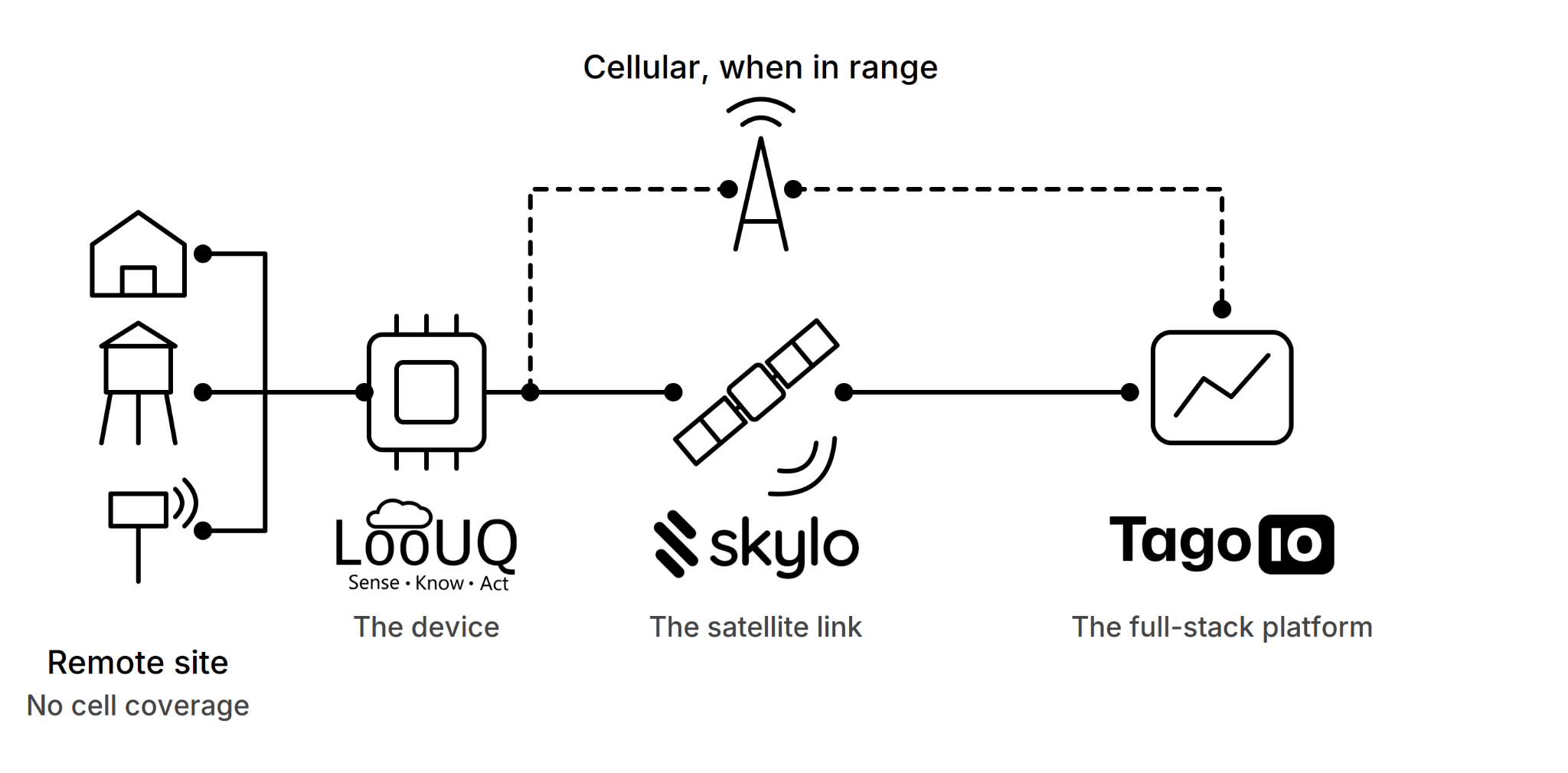
LooUQ builds the embedded modem that gets your product onto both cellular and satellite with minimum effort. LooUQ’s MTC2-N9151 carries LTE-M, NB-IoT, and NB-NTN in one low-power part, drops onto a board with two external components, and uses only two antennas that provide terrestrial LTE/satellite bands and GNSS reception. LooUQ provides a reference application ready for your “secret sauce”, the unique sensing your application performs. The MTC2-N9151 is built on Nordic's nRF9151 and inherits Skylo certification at the module level, so you skip a round of satellite testing that usually slows remote hardware. The device layer stops being the thing that holds up the project.
Skylo runs a standards-based 3GPP Narrowband (NB-NTN) service. When a certified device loses terrestrial cellular, it can roam onto satellite and keep reporting, then returns to cellular when it is back in range. Based on 3GPP standards, the way this operates is no different than how a mobile phone user roams onto different networks when travelling abroad. The link is narrowband by design: small messages, battery-friendly, built for telemetry rather than video. For a sensor in a field or along a pipeline, that is the difference between a daily reading and a dead spot.
Getting onboarded in two easy steps:
Once you have a device and SIM, how do you then send data over NTN to the cloud? Skylo operates an NB-NTN network. Built on 3GPP Release 17 NB-NTN, enhanced by Skylo Standards Plus, Skylo fully supports UDP. This means not HTTP, MQTT, or WebSockets. Almost none of the hyperscaler clouds support UDP ingestion, this is where TagoIO comes in.
TagoIO has a native UDP service built right into their service, this means all you have to do is point the device to send data to the endpoint provided by TagoIO and boom, you have data flowing from a device in the middle of nowhere into the cloud.
Once a reading reaches the full-stack platform TagoIO, the job shifts from moving bytes to seeing what they mean.
But why TagoIO, if other platforms visualize data too?
Plenty of tools can draw a chart. The reasons to put a remote, satellite-fed project on TagoIO show up around the chart, not in it.
Prescriptive analysis and security standards. TagoIO does more than show you the data: Analysis runs your own code against live readings to flag what needs attention and recommend the next move, so the platform points to the action rather than leaving you to read charts and guess. And the ground it runs on is built to be relied on: managed, resilient infrastructure that is ISO 27001 certified, so the readings you act on sit on a system audited to a known security standard.
A pre-built Skylo path. The integration is prepared ahead of time, so you do not build or maintain a connection per device. You point devices at a path that is set up once, and each one reports in through it.
Pricing shaped around transactions. You pay for the data that moves, not for the connection. There is no charge to connect to the network, and plans meter data input and output. Satellite telemetry is small and infrequent, so it stays in the lower tiers, with five devices free while you prove the idea.
Start where the work is
Remote sites no longer have to be the hard case. A LooUQ module and a Skylo connection reach the places cellular never did, and TagoIO turns what comes back into output you can act on, without a connection to wire for every device.
Read a step-by-step to start the journey on how to connect your hardware device to TagoIO.
How do I get IoT data from a farm or site with no cellular coverage?
Use a Skylo-certified module that supports 3GPP NB-NTN, such as LooUQ's MTC2-N9151. The device roams to satellite when cellular drops, and TagoIO ingests the data the same way it handles any device.
What does it take to deploy on Skylo?
Three things: a Skylo-certified module like LooUQ's, an NTN-capable antenna that covers Skylo's L-band and S-band frequencies, and a SIM from a Skylo operator partner.
Do I have to build a separate integration for every satellite device?
No. The Skylo path into TagoIO is prepared ahead of time. New devices report into the same path, and the payload parser decodes each one into named variables.
Why is TagoIO's pricing a good fit for satellite IoT?
You pay for data input and output transactions, and there is no charge to connect to the network. Satellite telemetry is low-volume and infrequent, so it stays in the lower tiers, and the free plan covers five devices while you build.