Satellite-to-device connectivity is usually sold as a simple story: you have blank spots on your coverage map, and the satellite fills them. For some use cases, that's true. But if you build connected products - fleet telematics, trackers, wearables, sensors, vehicles - whose devices move across strong, weak, and no cellular, "just add satellite" isn't a decision. It's the start that most teams underestimate.
The industry is standardizing fast, so the choices are clearer than a year ago. But there's still no single global satellite answer - and anyone who says otherwise is selling you their piece of the map.
Follow the packet
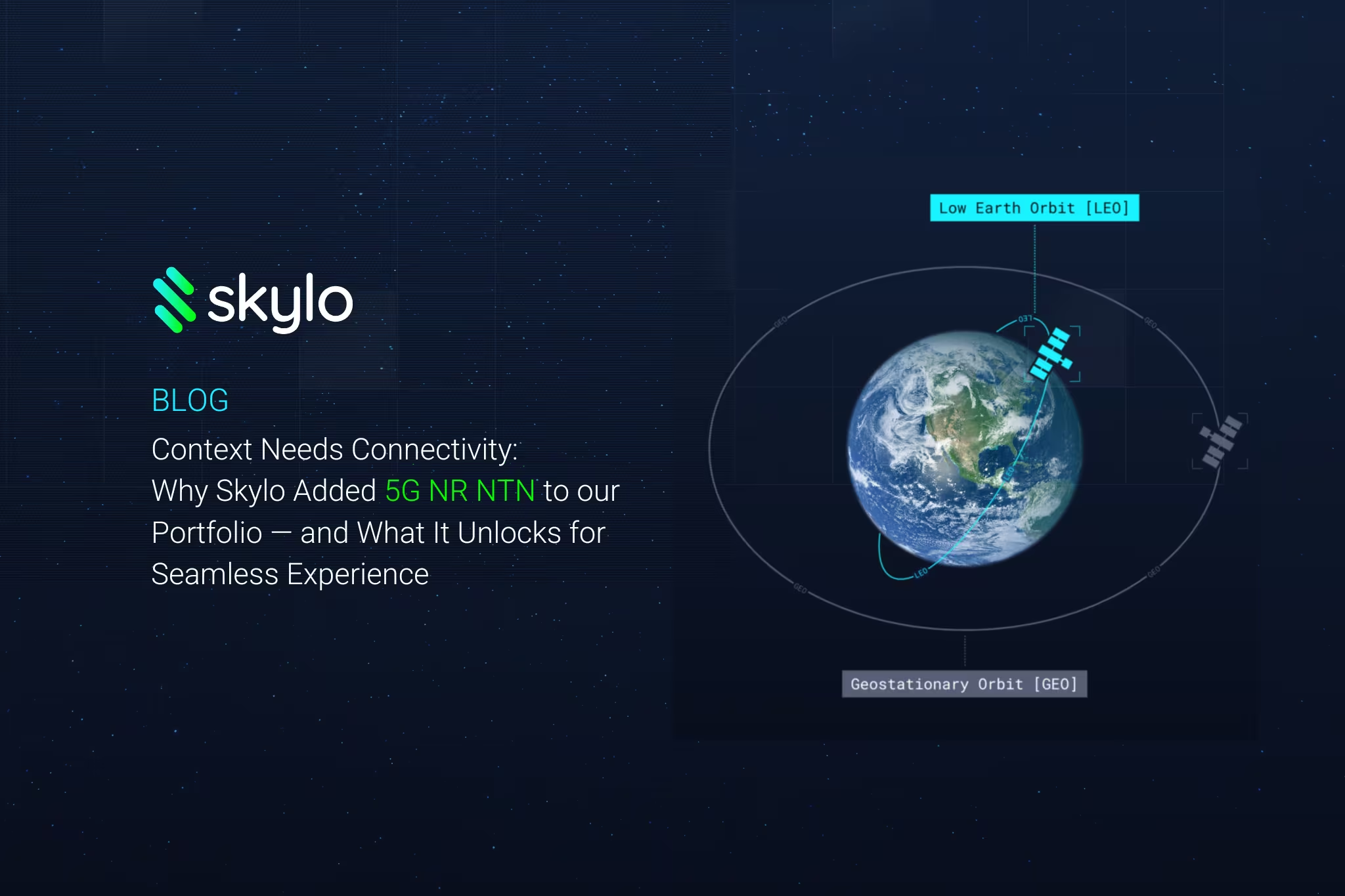
Trace the data from device to servers: it must reach a radio, travel to a satellite, return to a ground station, cross a core network, and land in your app. Every hop has to be true at once - in the country the device is in, over the technology you chose. So the "satellite question" is really several. What radio is in the device, certified against what? Which satellite, orbit, and spectrum? Whose ground network terminates it, and how does it reach your cloud? Get one link wrong and the map has holes.
Pick the tier that fits the job
"Satellite connectivity" isn't one capability. It comes in tiers as different as a text from a video call:
- Narrowband (NB-NTN): tiny, delay-tolerant payloads - a heartbeat, a location, ~1 KB - where power efficiency is everything. Runs over GEO satellites today; exceptional at pure reachability.
- Wideband (5G NR-NTN, and RedCap over NTN - emerging): more throughput for richer telemetry, interactive sessions, even constrained voice.
- Broadband: real bandwidth and streaming, but a different antenna, form factor, and cost.
The highest tier isn't the "best": it can do a lower tier's job, but power, antenna, module cost, and device size climb steeply with it. For most IoT and much of automotive, the right answer is the smallest tier that does the job - often narrowband NTN as an always-on layer that works when everything else fails.
Decide what satellite is for
It plays two very different roles. Primary: the device lives beyond terrestrial coverage and satellite is how it phones home. Insurance: the device is usually on cellular or Wi-Fi, and satellite guarantees it's never truly dark - an outage, a dead zone, the edge of a route. These lead to different tiers, power budgets, cost models, and deals. Name the role up front - it prevents costly mistakes.
How the chipsets are evolving
The silicon is moving - in a direction you can design for.
First, the satellite is arriving inside mainstream cellular chipsets, not as an exotic separate part. The pattern today is cellular plus narrowband NTN on one chip; satellite-only chipsets are the exception. So satellite capability now rides the cellular industry's cost curve and volume.
Second, the standards layer upward predictably. 3GPP Release 17 set the first normative NTN baseline chipsets ship against today. Release 18 added higher-band (Ku/Ka) support for higher-bandwidth terminals. Release 19, frozen at the end of 2025, brings RedCap-device support over NTN, regenerative payloads, store-and-forward for intermittent links, and steps toward reduced GNSS dependence - maturing through 2026–27.
Takeaway: what a chipset can do is a moving target, and it's moving toward you. Architect around one point-in-time capability - or one vendor's proprietary implementation - and you'll refactor in eighteen months. Design for the roadmap.
Three traps to avoid
- Proprietary lock-in. Some approaches require their chipset and only theirs, tying you to one vendor's roadmap and survival. Standards-based NTN lets you choose from a competitive ecosystem of chipset, module, and device makers. The optionality usually beats the premium.
- An unfinished constellation. The space segment is mid-build-out and consolidating. A few satellites in orbit with thousands planned can mean a pass every several minutes, not continuous coverage. Ask any partner what it covers today, where, and how the rest is funded.
- Satellite as a bolt-on. Antennas, power, form factor, and the certification path all change when NTN is in scope. Treat connectivity as an early architecture decision - follow the packet from day one.
Design to switch
Because no single technology or partner covers the globe, resilient products are built to switch. Modern eUICC and the emerging SGP.32 provisioning framework let a device carry its own logic for terrestrial-vs-satellite and which network to use where, instead of being hard-wired to one bundle. You don't have to decide everything now - just keep the ability to decide differently later, without re-spinning hardware.
Expect to stitch, not solve
Terrestrial telco is regional; satellite is global - but no single technology or partner is a complete global solution today. A worldwide deployment is assembled from several technologies that vary by country and orbit. Standards make that tractable: when device, radio, satellite, and core all speak the same 3GPP language, stitching happens inside a common fabric instead of across a dozen bespoke integrations. That's the Standardized Sky: satellite behaving like an extension of the mobile network you already run - with certification, roaming, and interoperability designed in, not bolted on.
Before you commit, ask
- Real data profile (bytes, frequency, latency) - and the smallest tier that meets it?
- Primary link or insurance layer?
- Does that tier fit the power/form-factor budget?
- Standards-based and multi-vendor, or proprietary and single-source?
- For each country you care about, what works today - not on the roadmap?
- What does the partner cover now, and how is the rest funded?
- Can you switch networks/technologies (eUICC/SGP.32) without new hardware?
- Have you budgeted certification - chipset, module, device/antenna?
Bottom line
None of this is a reason to wait. Standards-based satellite connectivity is commercially available today, across dozens of countries, on chipsets you can buy now - and it improves with every release. The teams that win bring the right mental model to the choices above. If you're working through them, that's the conversation we like to have.
To connect with the Skylo team, reach out at [email protected].
.avif)






























.avif)
.avif)

.avif)




.avif)
.avif)
.avif)


.avif)






.avif)
.avif)

%204%20-%20high%20res.avif)






.png)
.png)
.png)
.avif)
%20(1).avif)
.avif)
.avif)
.avif)
.avif)
.avif)
.avif)
.png)

.png)

.avif)
.png)
.avif)

.png)
.avif)
.png)
.png)