Satellite connectivity has entered a period of rapid and exciting change.
For decades, satellite systems operated within a relatively stable model, defined by long technology cycles, predictable players using proprietary technology, and well-understood regulatory frameworks.
That has shifted dramatically. Direct-to-device (D2D) services are now scaling globally, live across dozens of countries driven by a new wave of market entrants and unprecedented convergence of terrestrial and satellite mobile networks. Today's standardized consumer devices – carrying exponentially more processing power and functionality – are bridging the gap between space and cellular at a fraction of the cost of legacy hardware.
Regulators are therefore being asked to make decisions without clear historical precedent, and often under political, economic, and public pressure.
At Skylo, we approach regulation as an engineering and systems implementation challenge — how to introduce change in a way that works within existing frameworks, while enabling what comes next.
Based on our work with regulators globally, three things are becoming clear.
1. D2D builds on existing frameworks — it doesn’t start from scratch
D2D is not emerging in isolation. In many markets, it can be implemented within existing mobile satellite service frameworks, with careful adaptation to reflect how networks are evolving.
Current D2D implementation models today diverge primarily on spectrum and orbital strategies. D2D systems like Skylo's leverage well-established global satellite spectrum allocations, allowing for a more seamless integration into the existing regulatory framework. Other D2D systems explore terrestrial spectrum sharing for satellite use, which introduces complex coordination requirements to mitigate interference. Furthermore, the industry is moving toward a multi-orbit reality. In this respect, Skylo is agnostic – while we currently provide D2D service on geostationary satellites, our technology is fully compatible with non-geostationary systems as well.
What matters most is regulatory continuity.
The immediate opportunity for regulators is to extend existing mobile satellite service frameworks allowing seamless global connectivity — empowering devices to transition between terrestrial and satellite networks without technical disruption or unnecessary jurisdictional fragmentation.
While the industry is increasingly defined by a multi-orbit architecture, these orbital choices should not dictate a departure from proven spectrum models.
2. Spectrum decisions will shape how D2D scales
D2D is already operational at scale. Its future growth will depend on how spectrum is managed.
Many of the foundational allocations for mobile satellite services were made decades ago. Today, regulators are evaluating how to support new spectrum demands for a variety of use cases while balancing existing services, national priorities, and complex cross-border coordination.
Early decisions in this area will have long-term implications. As new D2D systems come online, their commercial viability will hinge on predictable spectrum access. Regulators must therefore work towards globally harmonized approaches that encourage interoperability and efficient spectrum use to be able to support these global services. More fragmented approaches may introduce complexity, leading to redundant infrastructure, higher costs, and inconsistent user experiences across global markets.
3. D2D is becoming a resilience layer — not just a coverage solution
While D2D is often framed as a way to extend coverage increasingly, it is being understood as a resilience layer.
When terrestrial networks are unavailable, during natural disasters, infrastructure failures, or in regions without coverage, satellite connectivity provides continuity. That still has profound implications for how countries think about critical infrastructure.
We are seeing growing interest from governments in how D2D can be integrated into emergency response systems, universal service frameworks, and national connectivity strategies.
The technology is advancing quickly. In many cases, the remaining challenge is ensuring policy frameworks reflect the essential role D2D can play — not only in extending coverage, but in maintaining connectivity when it matters most. Achieving this level of ubiquitous connectivity requires significant capital investment. To realize the full socioeconomic benefits of D2D, regulators should be mindful that their policies encourage, not discourage, implementation of these innovative services.
Toward a more standardized sky
As D2D evolves, policy choices will increasingly shape whether connectivity becomes more consistent across borders, or more fragmented.
At Skylo, we believe connectivity works best when it is integrated: across networks, countries, and industries. This perspective is grounded in practical experience of us working across regulatory environments, contributing to standards bodies, and supporting deployments that operate within existing frameworks while extending their capabilities.
Our role is to support regulators as they navigate these changes:
- Bringing a clear view of how D2D is evolving in practice
- Helping assess trade-offs across implementation models
- Supporting approaches that introduce innovation without destabilizing existing frameworks
The goal is not to replace what exists, but to build on it — enabling a more interoperable, efficient, and resilient layer of global connectivity.
Join the conversation at SATShow
Skylo will be at SATShow next week (March 23-25) in Washington, D.C.
If you’re working through spectrum policy, D2D deployment, or national connectivity strategy, we welcome the opportunity to exchange perspectives.
On Tuesday, March 24, Skylo CEO and Co-Founder Parthsarathi Trivedi will speak on the VIP panel: Can Satellite D2D Move Beyond Niche Basic Messaging to Mainstream? (From 3:45–4:45pm, Room 147 A/B), covering spectrum access, MNO relationships, standards evolution, and the path to 6G.
To connect with the Skylo team, reach out at [email protected].
###
About Mindel De La Torre, Head of Global Regulatory Affairs, Skylo
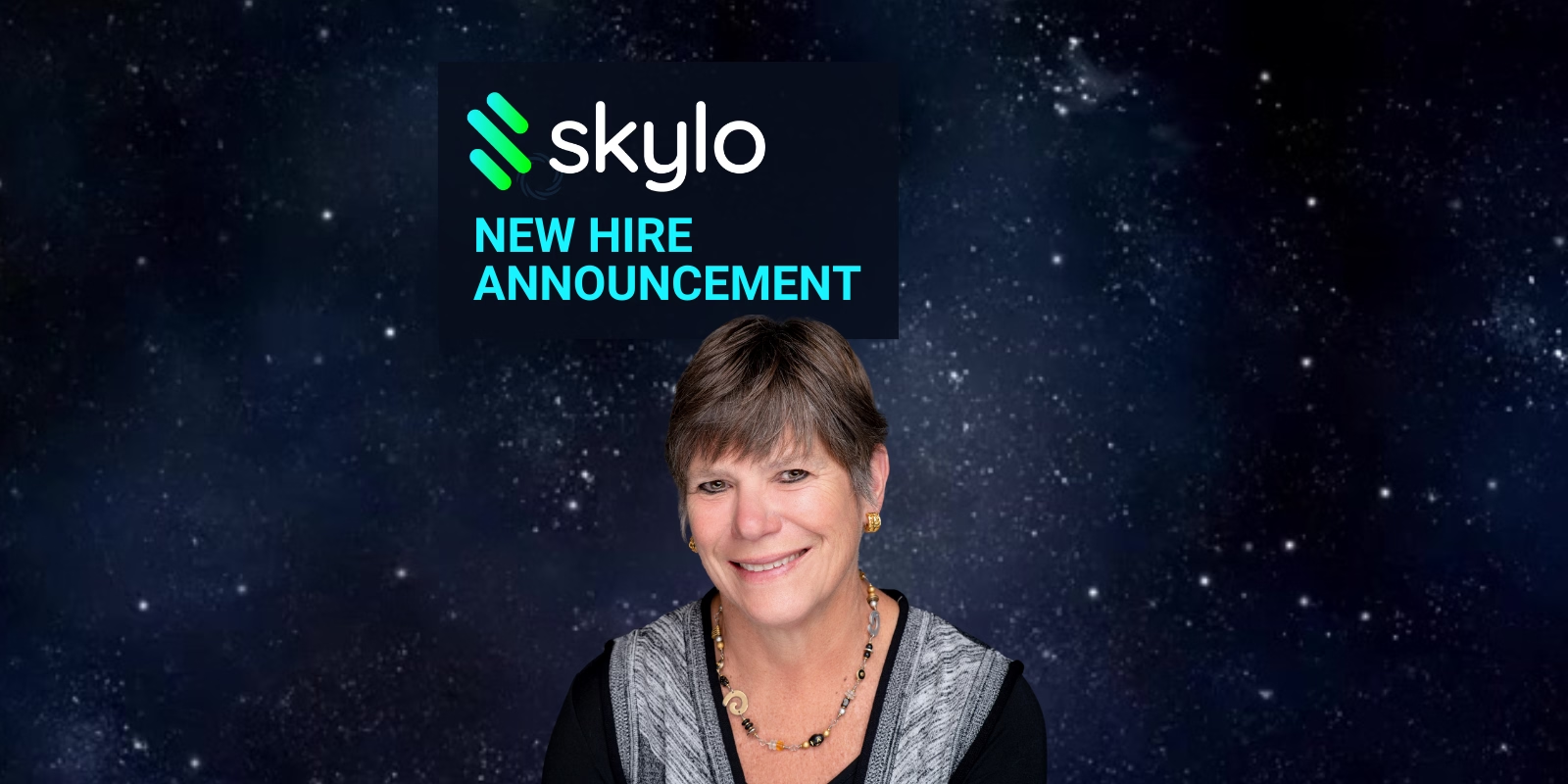
A recognized visionary leader in both government and the private sector, Mindel brings many years of expertise in telecommunications regulation and policy. As the Chief of the FCC’s International Bureau, she held senior leadership positions on U.S. delegations for bilateral negotiations and multilateral treaty conferences, including ITU World Radiocommunication Conferences. With deep knowledge in international telecommunications, licensing, and spectrum policy, she has a proven track record of securing critical approvals for satellite services and driving global market entry. Her leadership has shaped policy reforms that foster the adoption of next-generation terrestrial and satellite technologies, including non-geostationary satellite systems and direct-to-device non-terrestrial networks.



.avif)





















.avif)
.avif)
.avif)



.avif)
.avif)
.avif)


.avif)




.avif)
.avif)
%204%20-%20high%20res.avif)




.png)
.png)
.png)
.avif)
%20(1).avif)
.avif)
.avif)
.avif)
.avif)
.avif)
.avif)
.png)
.png)

.avif)
.png)
.avif)
.png)
.avif)
.png)
.png)
.png)
.avif)