For years, direct-to-device satellite has been framed as a coverage story. A way to fill the last few blank spots on a map — a safety net for hikers, remote workers, and emergencies.
This framing is understandable, but it’s also incomplete.
The real challenge isn’t simply where coverage exists. It’s whether connectivity can be continuous, reliable, and invisible — the way people already expect their mobile network to behave. In other words, the future of non-terrestrial connectivity won’t be defined by “satellite access,” but by seamless mobility, where the network layer disappears and the user experience remains positive.
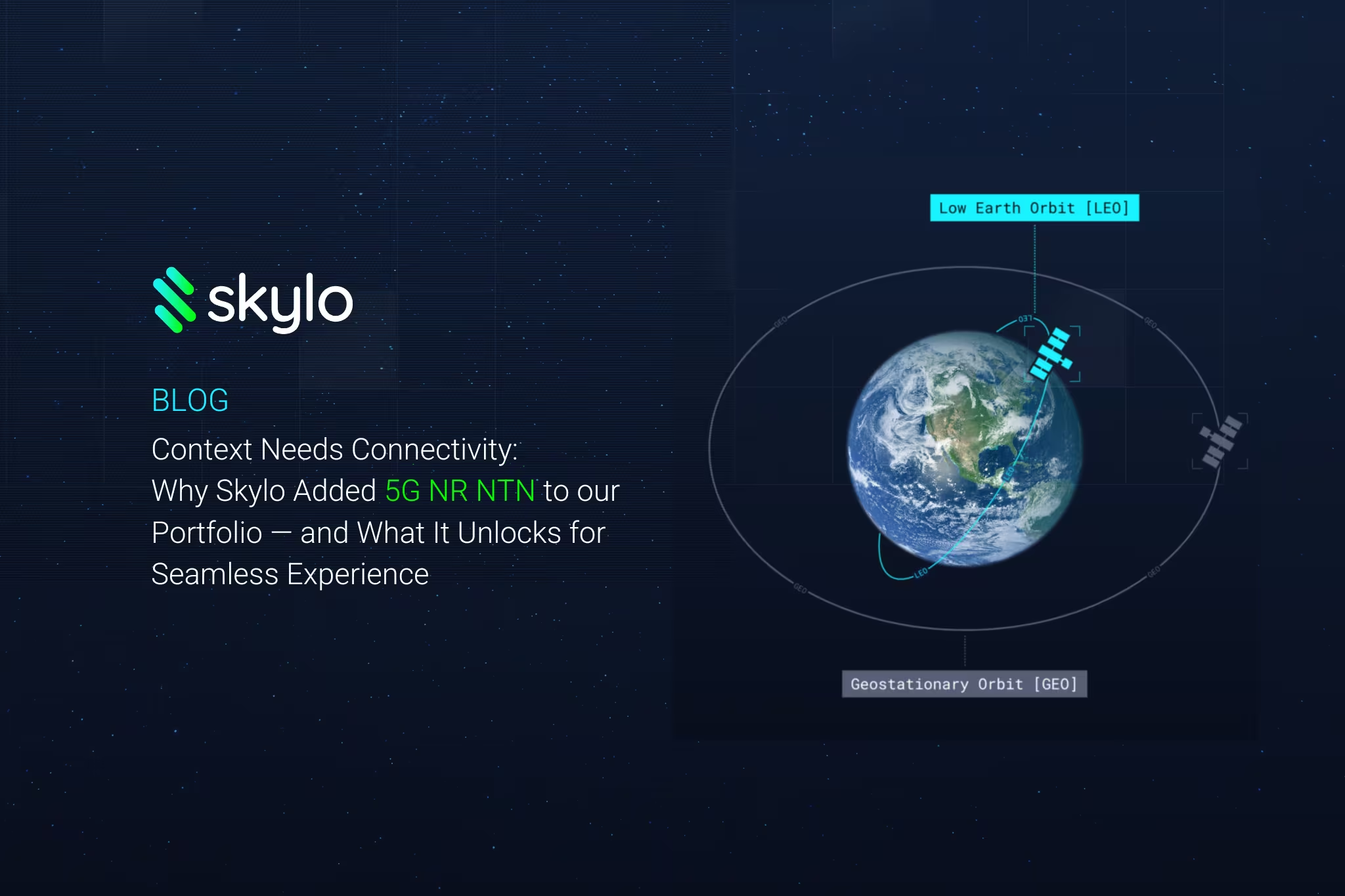
That is why our engineering team has been building toward 5G NR NTN. We see it as an architectural step toward what we believe the industry ultimately needs: a standardized sky that behaves like global mobile infrastructure.
The “invisible network” problem
Modern mobile networks are designed around a simple principle: "make before break". Your device doesn’t “switch networks” in a way you can feel. The transition is handled by the network so your call continues, your app session remains intact, and your experience doesn’t reset.
But many early satellite-to-device approaches operate differently. They often resemble “break before make”: terrestrial coverage fails first, then satellite becomes available as an alternate connection. That’s fine for emergency messaging. It’s not how you deliver the everyday reliability customers expect and increasingly need.
The next era of mobile isn’t just about higher speeds. It’s about guaranteeing persistent high-quality connectivity for daily life and for machines operating beyond the limits of terrestrial networks.
That is the problem our 5G NR NTN work is designed to solve.
Why 5G NR NTN matters, even before it’s commercially deployed
At Skylo, we’ve brought up and validated our 3GPP standards-based 5G NR NTN RAN. That matters for a very practical reason: it reinforces the idea that non-terrestrial connectivity can be an extension of the mobile network, rather than a parallel system requiring carriers to rethink everything.
We believe scaling NTN requires exactly that: continuity with the global mobile ecosystem, operationally, technically, and economically.
Complementary, not competitive: NB-NTN and NR-NTN
One of the biggest misconceptions in the market is that 5G NR NTN “replaces” NB-NTN. However, they are complementary pillars and together they broaden what “seamless connectivity” can mean.
- NB-NTN is exceptional for reachability: safety-critical services, lightweight IoT payloads, and ultra-efficient coverage extension.
- NR-NTN takes things further: higher throughput, greater mobility support, and more continuous experiences for data-heavy and interactive applications.
These aren’t competing bets. They’re two tools in one architecture, enabling carriers and ecosystem partners to match the right connectivity tool for the job, without fragmenting the user experience.
That’s why we continue to invest in both and will continue to support both.
The implicit link to tomorrow
There’s a lot of industry excitement around new constellations and new orbital strategies. That enthusiasm will continue. And yes: as the ecosystem evolves, capabilities like NR-NTN become increasingly relevant.
But the point isn’t any single orbit. The point is the model.
The industry doesn’t need dozens of bespoke sky integrations. It needs a path where satellite connectivity behaves like the network carriers already know how to run. Where devices don’t fragment by constellation. Where certification doesn’t multiply endlessly. Where roaming and interoperability are designed in, not bolted on.
That is what we mean by The Standardized Sky: a common fabric that allows non-terrestrial infrastructure to integrate into the global mobile system with consistency — for operators, device makers, and ultimately the customer.
Customer experience is the real north star
When we talk about “seamless connectivity,” it’s not abstract. It’s deeply human — and increasingly, deeply economic for carriers.
Customers don’t experience networks as towers, cores, or spectrum bands. They experience them as: did my call drop? Did the text send? Did the payment go through?
This is everyday reality. The “one-bar on your device problem.” The moments we’ve normalized as inevitable, even in places that are supposedly well covered.
As mobile networks compete for customer loyalty, consistency becomes a differentiator. And as connectivity underpins more machine-to-machine interactions — logistics, utilities, industrial monitoring, remote operations, the cost of inconsistency rises sharply.
This is where NR-NTN becomes meaningful: as an enabling capability for continuity at higher levels of performance and mobility.
Context needs connectivity
We’re also entering a period where “ambient intelligence” is moving from concept to product reality. AI experiences — assistants, agents, contextual services — don’t always require massive throughput. But they do require persistence. They fail when connectivity breaks, because the intelligence loses context.
That is why we’re building toward a future where the network layer becomes invisible. Where devices and applications aren’t forced to manage connectivity gaps.
Non-terrestrial networks will ultimately be judged on one thing: their ability to deliver seamless, high-quality, continuous connectivity at global scale. Narrowband NTN delivers that reliability today. NR-NTN is the path toward richer, more capable services tomorrow. The Standardized Sky is what unifies both — ensuring satellite operates as an extension of the mobile network, not a separate ecosystem.
That’s how we believe this category matures. Not through fragmentation. Through integration.
And it’s the work we’re committed to keep leading.




.avif)






















.avif)
.avif)

.avif)




.avif)
.avif)
.avif)


.avif)







.avif)
.avif)

%204%20-%20high%20res.avif)






.png)
.png)
.png)
.avif)
%20(1).avif)
.avif)
.avif)
.avif)
.avif)
.avif)
.avif)
.png)

.png)

.avif)
.png)
.avif)

.png)
.avif)
.png)
.png)