The Arctic Circle’s unforgiving vastness makes it an unlikely proving ground for cutting-edge IoT connectivity. Its landscape includes snow-dusted mountains, deep valleys, and endless wilderness. Yet, a dedicated Tele2 IoT team ventured there to test IoT connectivity and applications. In partnership with Skylo, they pushed Direct-to-Device, Non-Terrestrial Network (D2D NTN) communication boundaries. Their mission: validate a new satellite IoT offering’s quality and user experience. They focused on the most challenging conditions. What they discovered exceeded expectations. It also reshapes our understanding of reliable IoT connectivity’s true reach.
The “Why”: Extending the Network to the Edge of the World
Terrestrial mobile networks operate where people live and go. This leaves vast coverage gaps in remote areas. However, for IoT, many devices often operate where people are not. They monitor critical infrastructure, track assets, or enable environmental sensors in distant locales. A Non-Terrestrial Network (NTN) steps in as a vital extension – essentially a cellular network where the base stations are located on satellites in orbit around Earth.
Tele2 IoT’s offering uses a Direct-to-Device (D2D) approach, which is a game-changer. Traditionally, satellite connectivity for IoT often required proprietary, expensive devices, or for the customer to deploy ground-based gateways. This led to dedicated, unpractical, and costly solutions, prohibiting widespread adoption. The D2D NTN model, however, allows the same device to communicate directly with both the traditional terrestrial network and the satellite network. It bases on technologies similar to traditional networks. This greatly improves hardware cost and availability, facilitating widespread adoption.
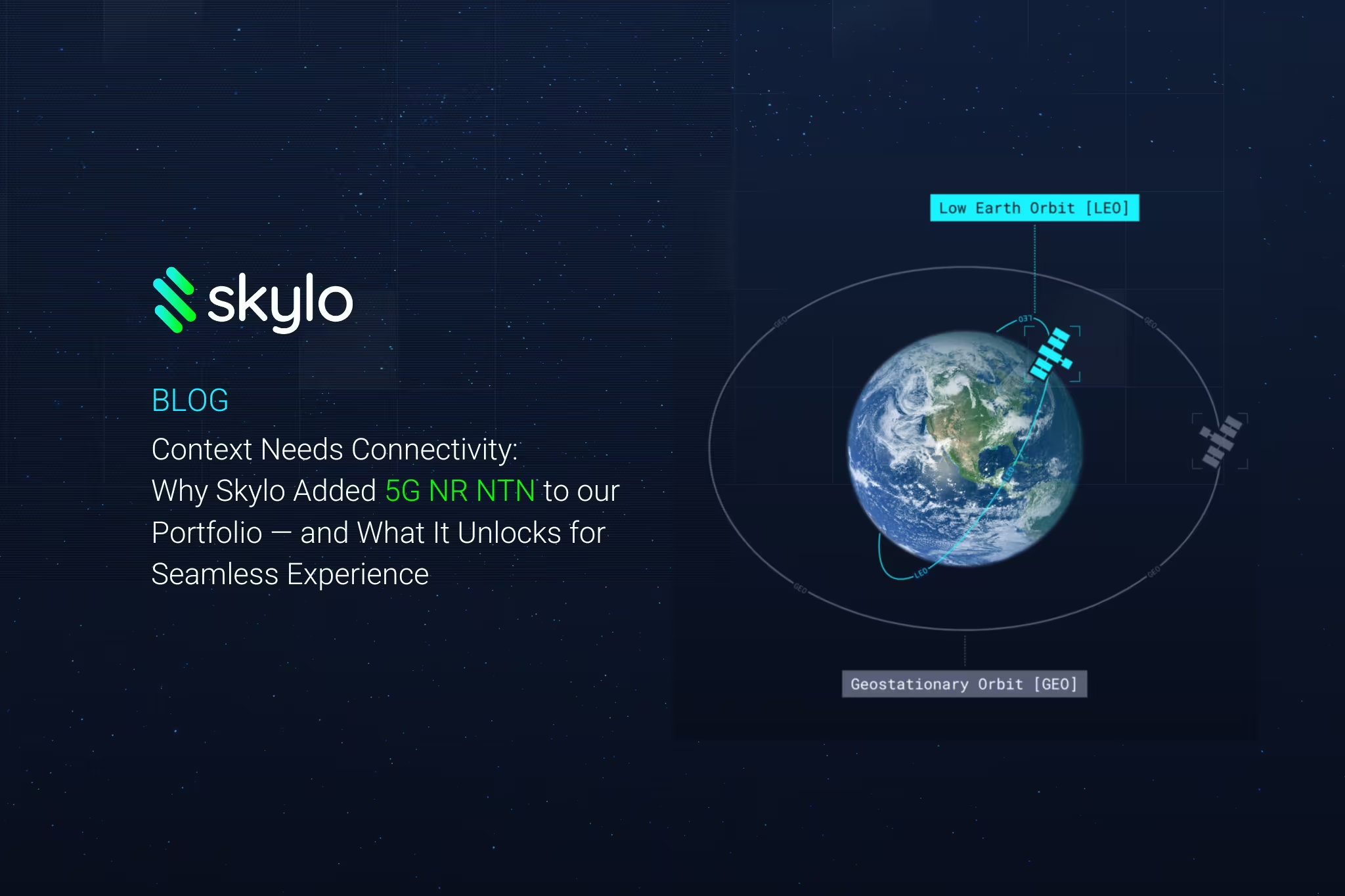
The choice to test in the Arctic Circle was not arbitrary. Skylo’s network relies on geostationary (GEO) satellites. These satellites orbit along the Earth’s equator, making equatorial locations ideal for signal reception since the satellite remains directly overhead and in a constant position above the earth. Moving further north or south towards the poles makes the satellite appear lower on the horizon. This increases the likelihood of obstructions from mountains, trees, or buildings, thus blocking the line of sight to the satellite and increasing the risk of a weaker or non-existent signal.
We wanted to really push it. We wanted to see how this would work in the more challenging conditions, basically the furthest points where we can get away from the optimal conditions. Christian Seglert, Product Manager at Tele2 IoT
The goal was clear: to validate the theoretical coverage maps and gather tangible proof that Tele2 IoT’s satellite services could confidently provide coverage to their customers even in challenging locations.
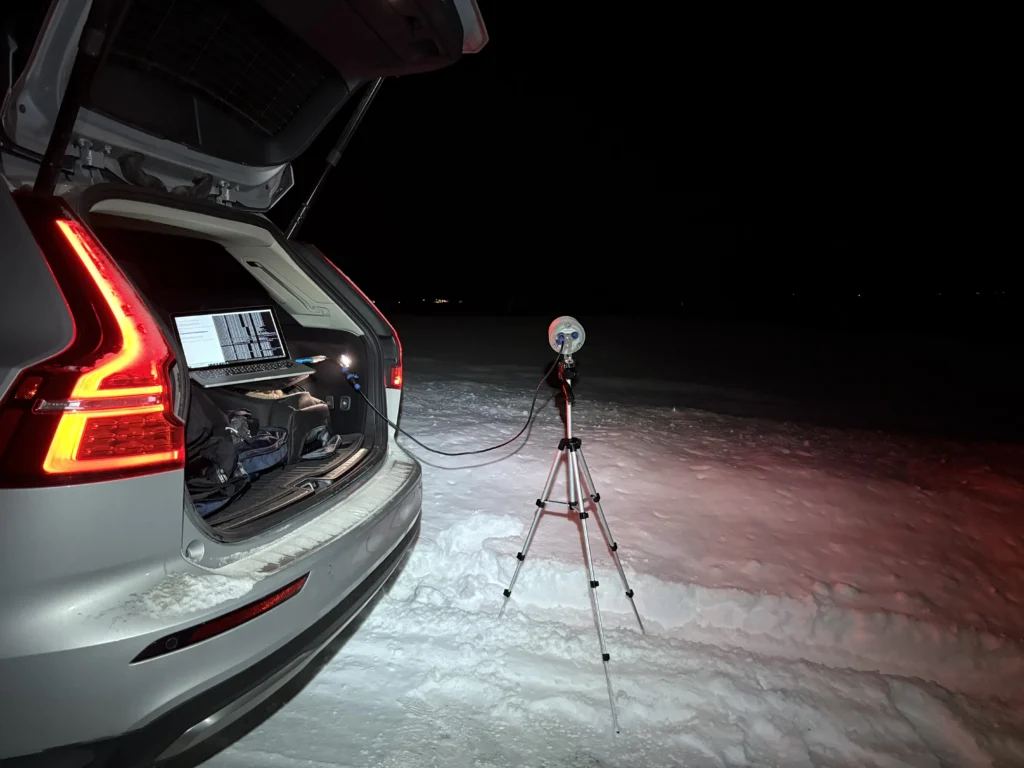
Testing in the darkness in Laksvatn, Norway
Into the Frost: The Expedition Experience
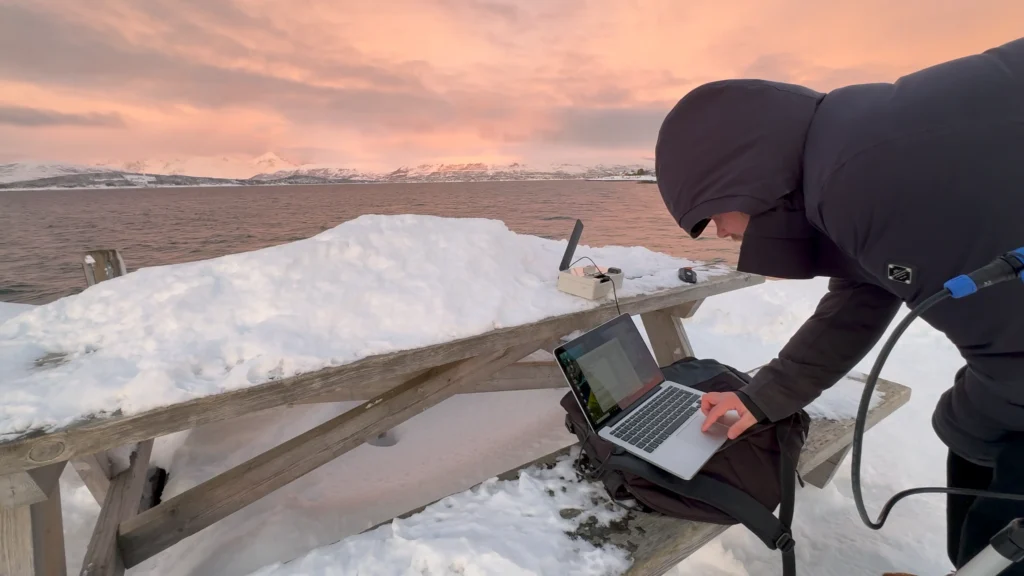
The team faced extreme conditions from the outset. Temperatures plummeted to -26°C (-15°F), and the prolonged darkness of the Arctic winter presented its own unique challenges. While the IoT devices themselves proved remarkably resilient to the cold, the accompanying laptops, crucial for controlling tests and collecting data, struggled. “A laptop battery doesn’t work very well in that kind of temperature,” Christian recalls. This meant swift action was key, with testers quickly completing tasks before batteries died.
Despite the technical hurdles, the expedition was an adventure. The team savored local delicacies like reindeer burgers and moose meatballs, and had memorable encounters with wildlife, including navigating roads filled with reindeer crossings. “It’s always cool to really test out new technology out in the field in the real world, not just to kind of do it from behind a PowerPoint presentation,” Christian shared, highlighting the motivating spirit of the trip.
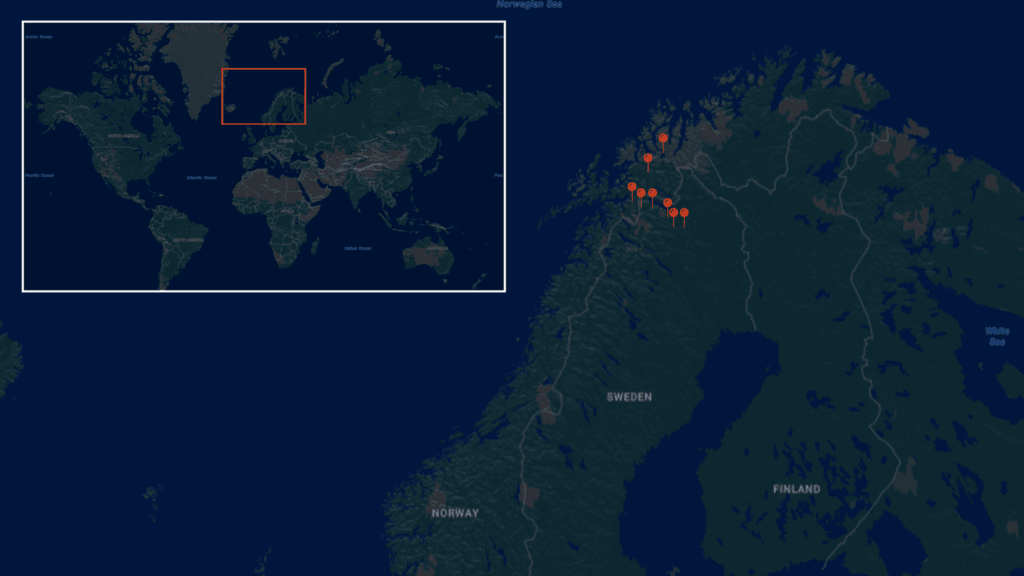
The expedition focused on comprehensive testing using three distinct devices: a development board for optimal device control, a small ready-made messaging and emergency device (showcasing an example of a final product), and an industrial IoT application device. All of the devices used for these tests were from the Skylo certified device list. Testing occurred across eight stationary locations with varied terrain – from open plains to dense forests and mountainous areas – as well as during continuous drive testing and even a border crossing.
Map of test locations
The findings were remarkable, directly challenging common misconceptions about satellite IoT:
Reliable Coverage All the Way to Tromsø: The network provided consistent, reliable coverage as far north as Tromsø. Devices attached to the network reliably, similar to performance in more southern locations, and successfully sent and received data.
Beyond Line of Sight: A significant breakthrough occurred when devices connected successfully even behind trees and mountains without direct line of sight to the satellites. Christian recounts a moment of surprise: “We just saw a big mountain and we’re like, this is never going to work, but let’s try. And we tried, and it did work”. This demonstrates that the signal can propagate in unexpected ways, directly debunking the fear that a crystal clear line of sight is always required.
Connectivity on the Move: Even from inside a moving car, with a device placed on the windshield, data was successfully attached, sent, and received. While an external antenna would optimize performance, this finding demonstrates unexpected resilience in dynamic environments.
Seamless, Smart Roaming: The transition between terrestrial (cellular) and satellite networks worked well. The service acts like a fallback network meaning that a device can seamlessly connect to the satellite when terrestrial service is unavailable, then revert to terrestrial when it becomes available again. An example use case illustrates this: a device connects to a terrestrial MNO network, then seamlessly switches to satellite as it leaves the city, and travels into more rural areas where terrestrial coverage is not present. It then reverts to the terrestrial network when returning to the city.
Connectivity that knows no borders: When operating in rural areas without a terrestrial network present, the devices kept their connection with the satellite even when moving across country borders.
Satellite IoT is more useful than you think, it’s not fragile, it’s not limiting”. Christian Seglert, Product Manager at Tele2 IoT
These tests proved that the service can reliably operate in conditions previously thought to be too challenging.
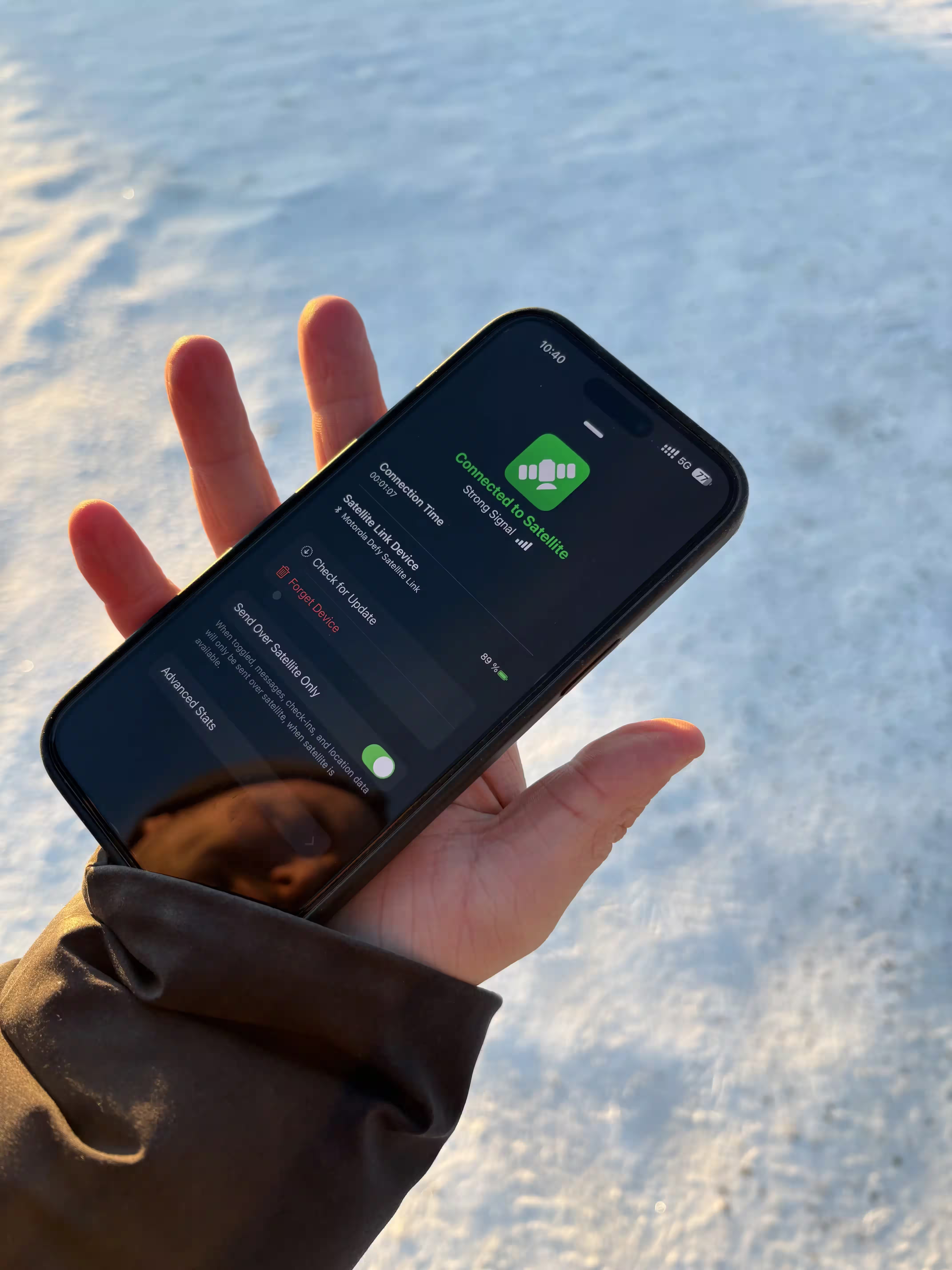
Confirming strong signal with the chosen ready-made messaging and emergency device in Kiruna
Why Skylo: The Power of Geostationary Satellites
Tele2 IoT’s partnership with Skylo is strategic, leveraging Skylo’s unique strengths in the satellite IoT space. Skylo builds its coverage through partnerships with existing satellite operators, utilizing their infrastructure and frequency rights.
Constant Coverage: Unlike Low Earth Orbit (LEO) constellations, which offer intermittent coverage as satellites pass overhead, Skylo’s GEO satellites are stationary compared to the Earth at an altitude of approximately 37,000 km. This means the network is there all the time, providing continuous and contiguous connectivity without waiting for a satellite to pass.
Maturity and Reach: Skylo is considered the most mature and established NTN provider of IoT in the market, with commercial launches in North America, Europe, Brazil, Australia, and New Zealand.
Perfect Fit for IoT: While GEO satellites aren’t designed for streaming high-bandwidth content, they are an ideal match for the low-data requirements of most IoT applications. Skylo offers up to 20 packages per minute, with a maximum package size of 1024 bytes, and a latency of approximately 15 seconds. For context, an SMS contains 140 bytes of information. “You don’t need to have 100 megabits to send a measurement value,” the team points out. The service is technically similar to NB-IoT (Narrowband-IoT), which is known for its low power consumption and suitability for small data packets. This means that NTN-capable NB-IoT modules are primarily used, though not all NB-IoT modules work by default.
LEO vs. GEO Satellite Connectivity for IoT
Feature
Low Earth Orbit (LEO)
Geostationary Orbit (GEO)
Altitude
~1,000 km
~37,000 km
Movement
Moving relative to Earth
Stationary relative to Earth (orbit synced with Earth’s rotation)
Coverage
Many satellites (100+ for continuous service); global (if pole-to-pole)
At least three satellites are enough to cover the globe
Availability
Intermittent access; only when a satellite is overhead. Example: A 4-satellite constellation gives a 6h revisit time and ~30s communication window. Messages are then stored and sent to a ground station when available (up to 4 hours later).
Continuous; network is always available (like a terrestrial network)
Throughput
Up to ~10 Mbit/s (when available)
Up to 20 packages/min (1024 bytes max package size)
Latency
~50 ms (when available)
~15 s continuously
The Future: Connecting the Unconnected
This successful Arctic expedition empowers Tele2 IoT, being able to confidently offer solutions addressing critical customer pain points. Industries like environmental monitoring, remote infrastructure management (e.g., wind farms or rural electrical grids), or emergency communications can now rely on robust connectivity. This was previously impossible.
The next step involves close collaboration with customers. Tele2 IoT will support their customers as they optimize their specific use cases and devices to fully leverage this proven satellite network’s capabilities. The Tele2 IoT Arctic expedition was more than just a test. It was a testament to innovation. It pushed connectivity boundaries to enable a truly connected world, no matter how remote.
Test-setup at our most northern test-location in Tromsö


.avif)





















.avif)
.avif)

.avif)




.avif)
.avif)
.avif)


.avif)





.avif)
.avif)
%204%20-%20high%20res.avif)






.png)
.png)
.png)
.avif)
%20(1).avif)
.avif)
.avif)
.avif)
.avif)
.avif)
.avif)
.png)

.png)

.avif)
.png)
.avif)

.png)
.avif)
.png)
.png)
.png)
.avif)