SMP Document v0.2: Jul 24, 2024
Purpose:
Skylo offers a global NTN network, leveraging the standardized 3GPP ecosystem to offer seamless hybrid connectivity for LPWAN use cases on existing geostationary satellites. This network complements terrestrial networks and acts as a roaming partner for the terrestrial network operator, allowing subscribers an enhanced coverage and accessibility experience
This document is to guide the terrestrial cellular operator with the required system integration between the 3GPP compliant Skylo core network to the customer endpoint
Reference Document https://www.gsma.com/newsroom/wp-content/uploads//IR.88-v21.0.pdf
Introduction
Skylo Network
Skylo offers a global NTN network, leveraging the standardised 3GPP ecosystem to offer seamless hybrid connectivity for LPWAN use cases on existing geostationary satellites. This network complements terrestrial networks and acts as a roaming partner for the terrestrial network operator, allowing subscribers an enhanced coverage and accessibility experience. Importantly, access to Skylo’s network requires no change in the user hardware nor any additional/special antenna, as long as the device uses a certified modem capable of R-17 NB-IoT NTN and meets the Skylo network specifications.
This document is to guide the terrestrial cellular operator with the required system integration between the 3GPP compliant Skylo core network to the customer endpoint.

Device Certification
Devices connecting to the Skylo network should be certified by the Skylo certification team and should follow operation guidelines in the device certification document which will be provided to the device OEM’s
This device certification document is to guide device manufacturers with requirements, usage policies and best practices for designing devices and solutions that will operate on Skylo’s satellite network.
- Requirements ensure devices on the Skylo network are compliant with all applicable regulations and operate in a manner compatible with Skylo’s systems
- Best practices provide suggestions for device configuration and application design to make optimal use of the Skylo network, resulting in the best possible experience for end users of the service
Skylo will provide a certification to devices which have demonstrated compliance with the stated requirements, enabling these devices to access Skylo’s satellite NTN network
Service Description
Techical Description
Skylo offers a global (NTN) network over satellite. Device manufacturers and providers of wireless IoT solutions can leverage Skylo’s network to extend the reach of traditional cellular IoT solutions to include satellite coverage that is always on and available anywhere devices can see the sky. This hybrid cellular/satellite connectivity is available using standard cellular IoT device hardware with compatible chipsets.
A typical subscriber device would connect over the terrestrial network, and as the device travels outside of terrestrial coverage it would then connect to the satellite network and finally as the device returns to terrestrial coverage the device would reconnect to the terrestrial network. Skylo supports and facilitates this seamless transition, with the goal of being on the terrestrial network for the majority of the time.
Service Subsystems
Data Pathway
Skylo IMSI - Authentication at Skylo HSS and Local Breakout
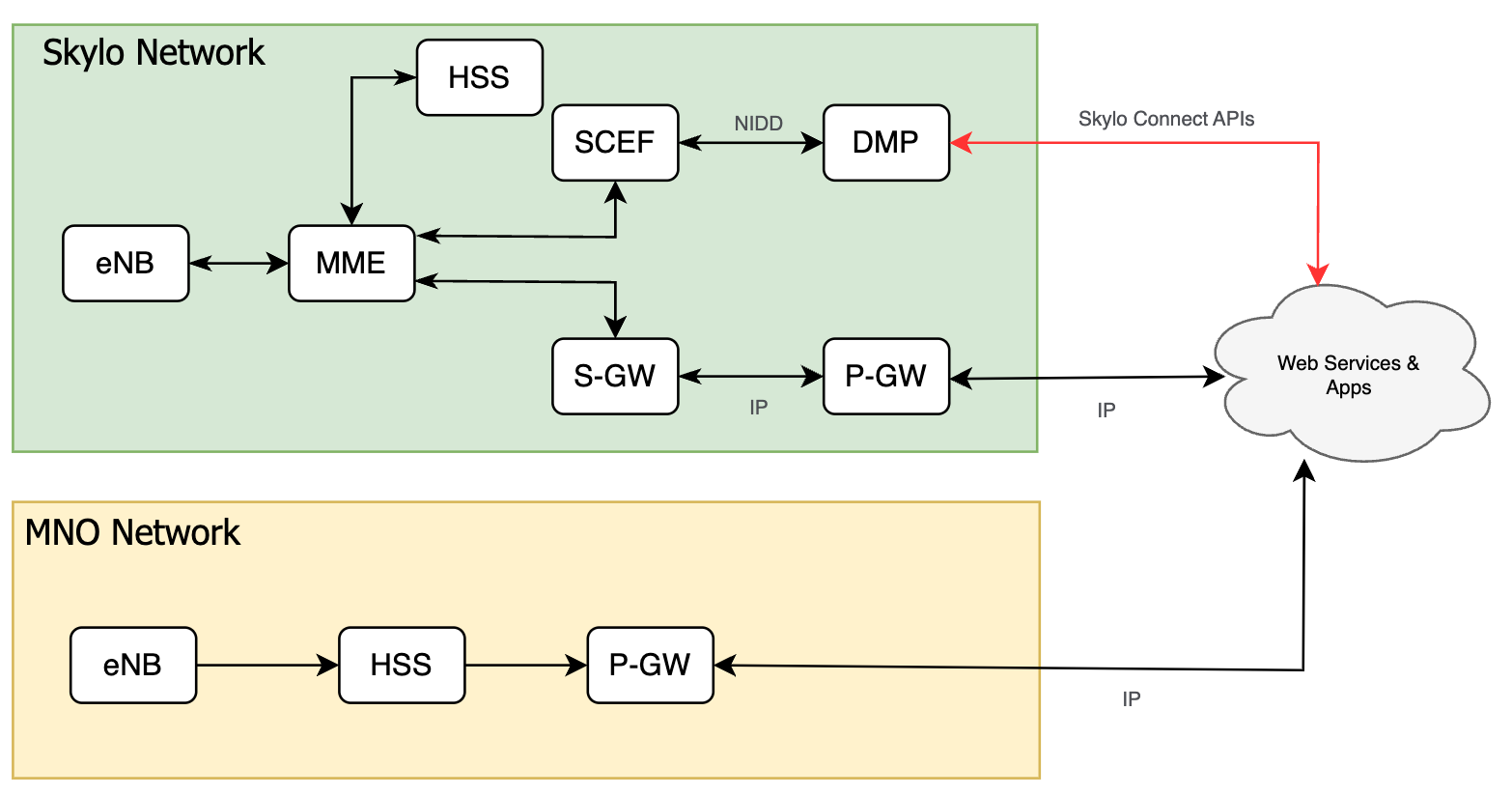
In this scenario, Where the end enterprise has a direct commercial contract with Skylo and are using Skylo IMSI for NTN along with the MNO IMSI for Cellular. subscriber devices will have an independent Skylo IMSI for the Skylo network. Subscriber Devices will connect to MNO networks wherever the cellular network is available using the MNO IMSI. When devices go out of the cellular range, they will look for the Skylo network. While connecting over the Skylo network, the device presents the Skylo IMSI to Skylo MME. The Skylo MME will use Skylo HSS for authentication. Upon successful authentication, IP/ Non-IP data packets to/from the Subscriber devices flow through the Skylo SCEF adapter/P-GW from/to the external endpoint. This flow is summarised in the figure below.
MNO IMSI - Authentication at MNO HSS and Home Routing
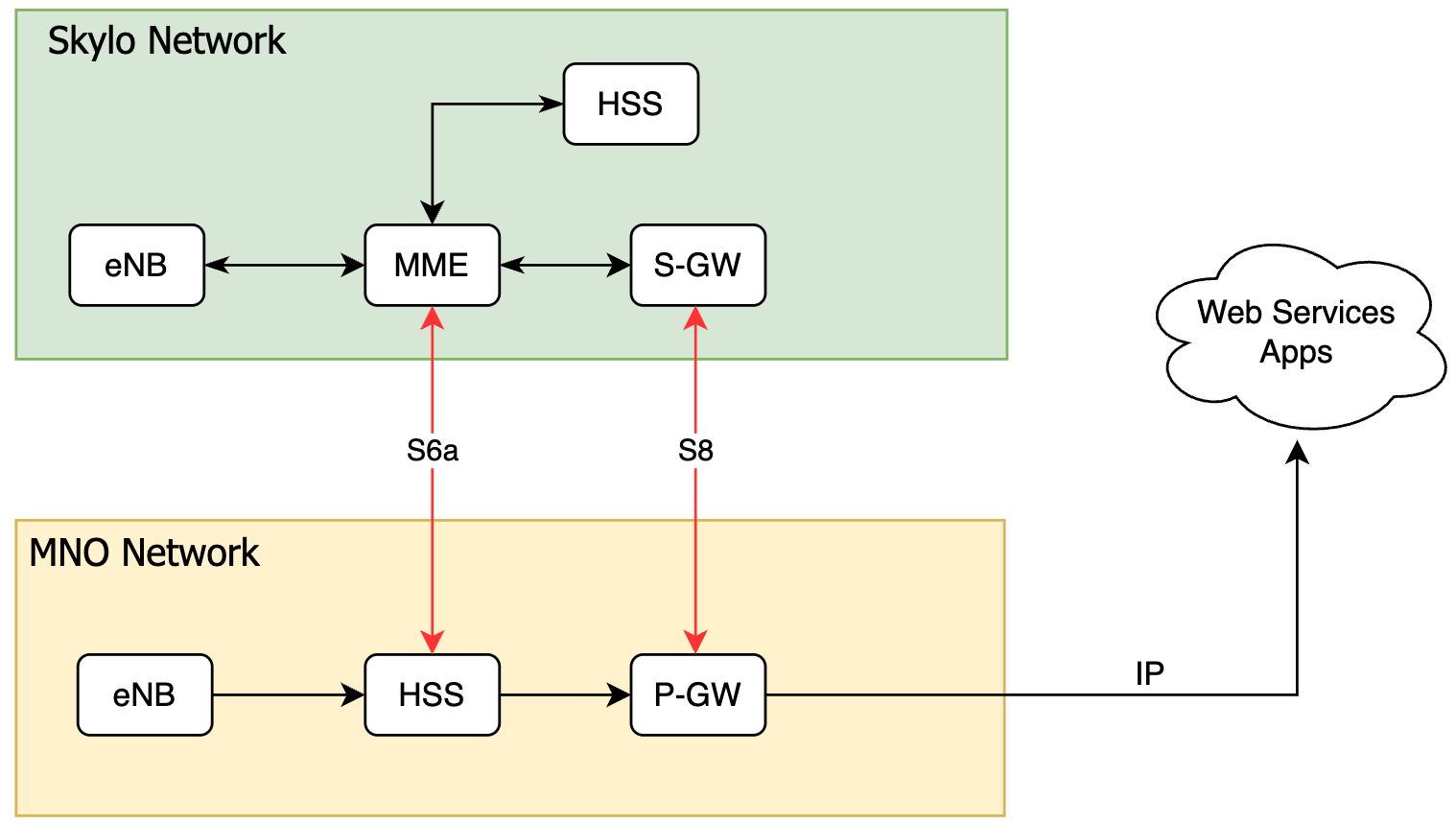
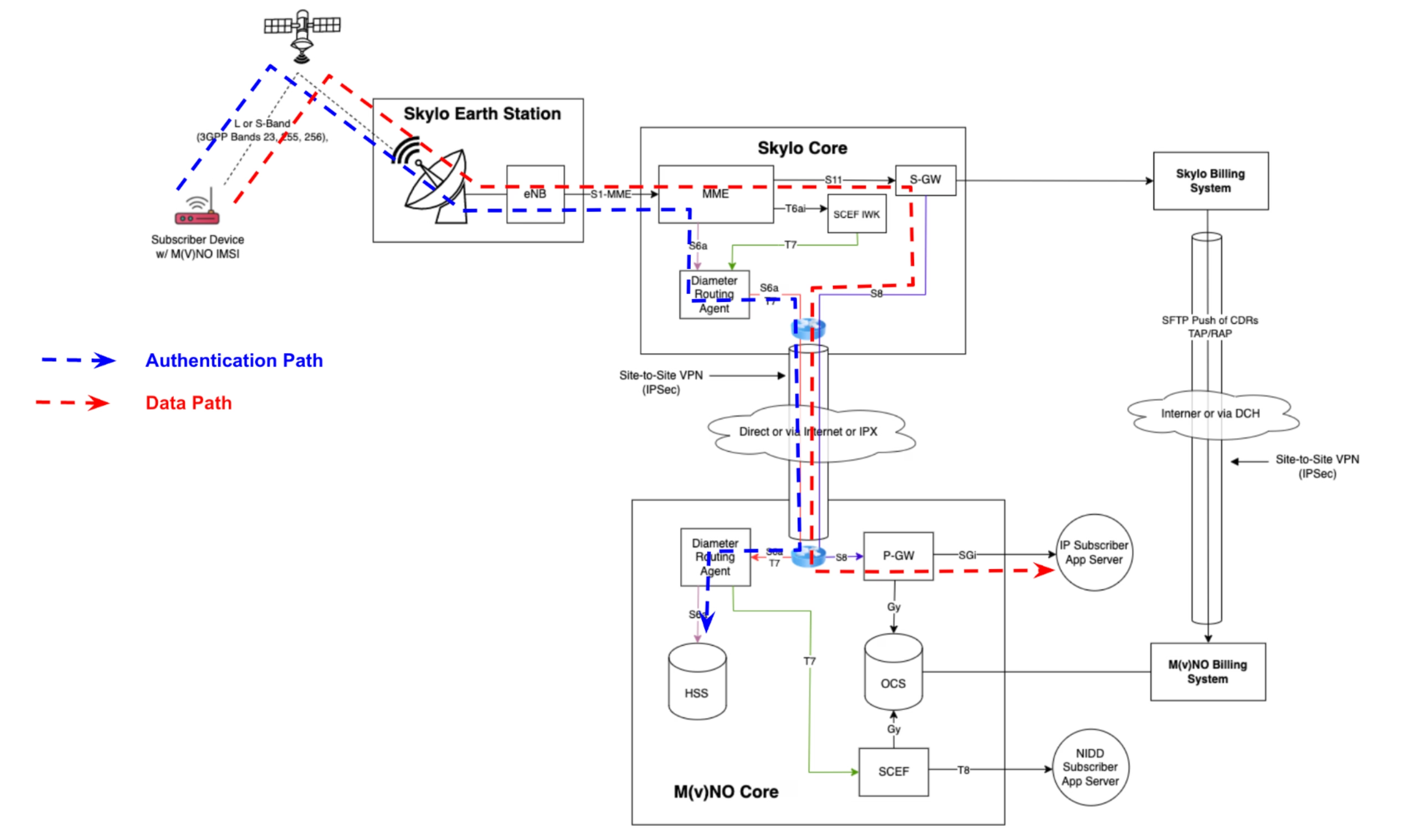
In this scenario where MNO IMSI are being used for Hybrid connectivity, the subscriber device presents the MNO IMSI to Skylo MME. The Skylo MME will use MNO HSS for authentication via an S6a interface. Upon successful authentication, IP packets from the Subscriber devices are routed from the Skylo S-GW to MNO P-GW via an S8 interface. This flow is summarised in the figure below.
MNO IMSI - Authentication at MNO HSS and Home Routing for Native SMS
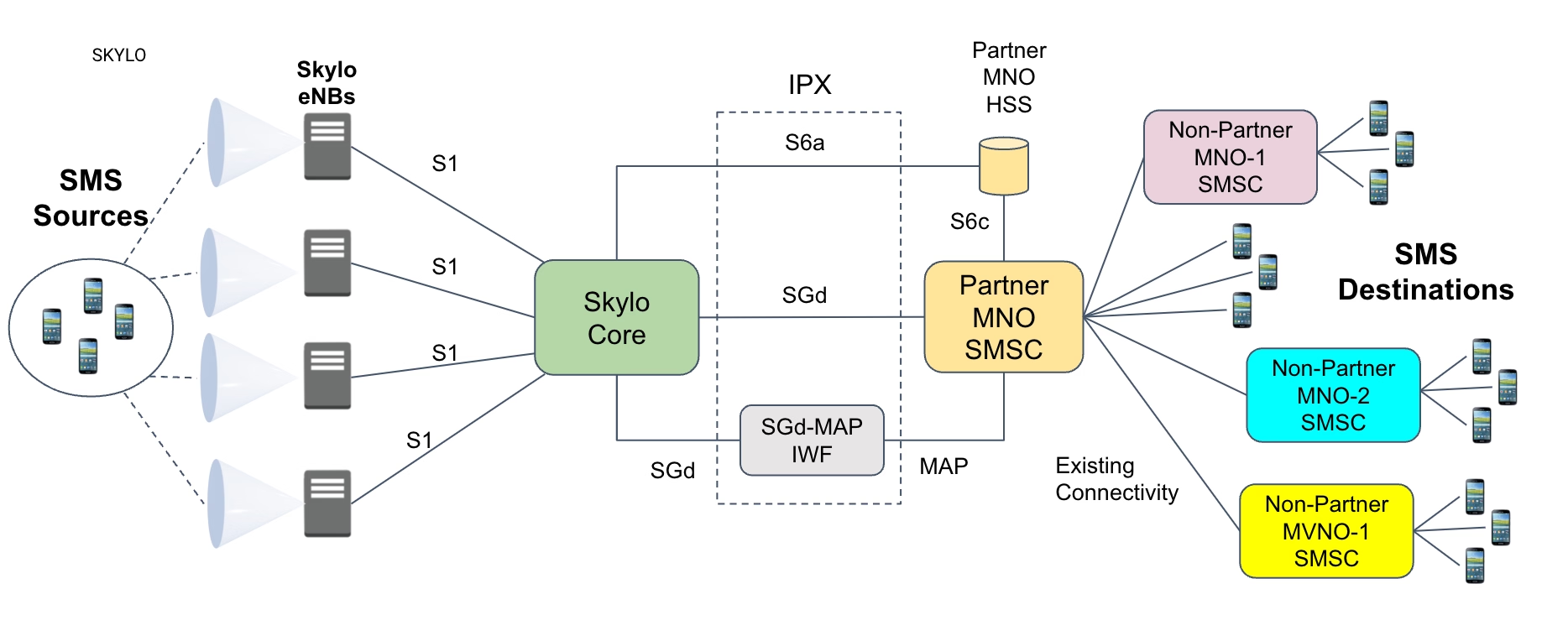
In this scenario where MNO IMSI are being used for SMS over Satellite, the subscriber device presents the MNO IMSI to Skylo MME The Skylo MME will use MNO HSS for authentication via an S6a interface. Upon successful authentication, Skylo will use the SGD interface to send SMS.
SMS-o-NAS messages are exchanged directly between Skylo’s MME and the Skylo Partner MNO SMSC via SGd or MAP interfaces
- MAP (2G/3G) requires an SGd-MAP Interworking function (IWF) from a 3rd party like an IPX
Billing, Activation, Deactivation only for Skylo IMSIs
Access to the Skylo SIM Management and Provisioning System (SMPS) is given by secure APIs to activate and deactivate specific or a set of Skylo IMSIs to the Skylo network. The Skylo SIM Management and Provisioning System (SMPS) maintains and manages a list of subscribed Skylo & IMSIs for billing and network access purposes.
Billing is only meant for wholesale customers and is not meant for retail transactions or customers.
IMSI Activation/Deactivation via APIs
These APIs are consumed by the Skylo customer’s BSS. Customers are onboarded through Skylo BSS-CRM and a unique entity-id is assigned to it.
SIM application service (SMPS) generates a secret key for each entity-id for accessing SIM APIs. Each APIs request shall contain the entity-id and secret key to securely access the SIM APIs. These values shall be used in HTTP headers as shown below:
- ENTITY-ID: <entity-id>
- Authorization: Bearer <secret-key>
During Customer Onboarding:
- CRM to capture details of APN, Service type & region of service list
- CRM to look for available apn and issue to customer/ASP
- APN are pre-configured onto Core-nw
- SMPS validate IMSI belongs to which Customer
- Check duplication of IMSI
Quota (credit) enforcement for Skylo IMSIs
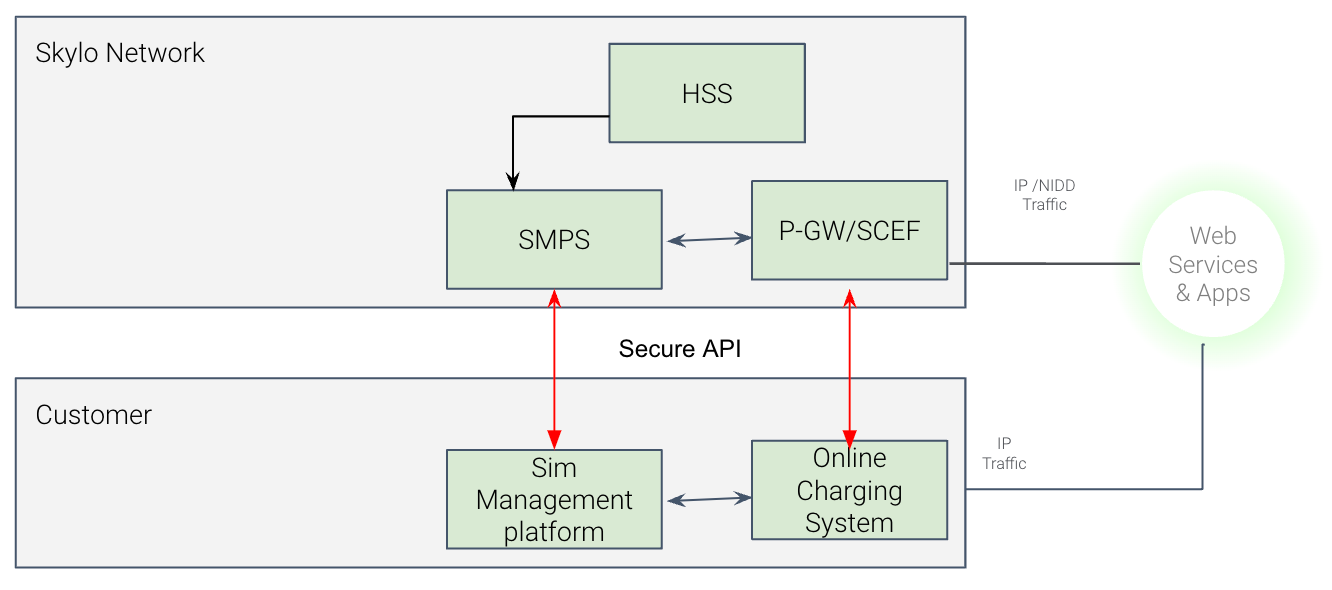
In case of Quota enforcement, for local breakout cases, it is the responsibility of the customer BSS platform to enforce the quotas on the Skylo PGW or SCEF adapter. In addition, they need to call the Skylo deactivation API to deactivate the IMSI on the Skylo Network. To restore access, the IMSI needs to be reactivated.
This integration is summarised in the figure below.
Billing, Activation Fee for M(v)NOs IMSIs
IMSI Activation Fee will be charged the first time an IMSI sends or receives data on the Skylo network and invoiced on the first of the subsequent month and Quota enforced can be through rejection of authentication requests, rejection of PDN requests and deletion of PDN contexts by M(v)NOs
Billing Integration to share CDR
Skylo will provide monthly Call Detail Records (CDRs) on a push basis to the M(V)NO’s secure FTP server. This is summarized below:
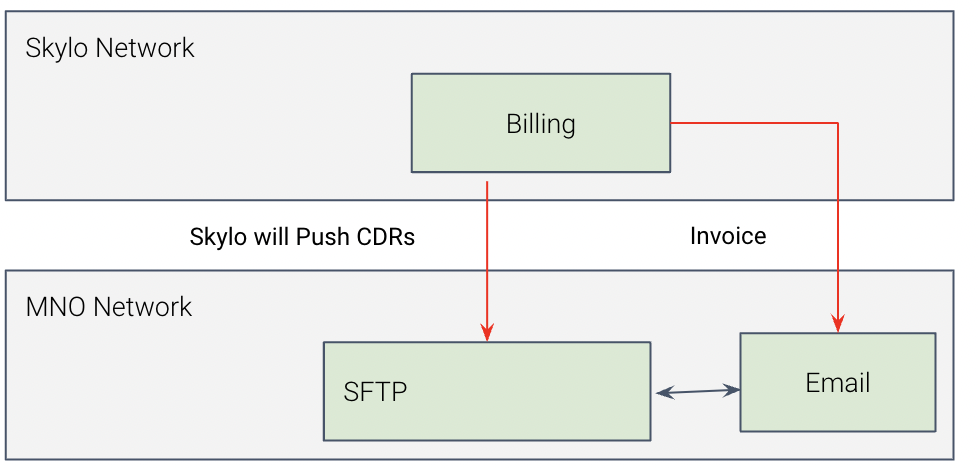
These call data records will record every single packet transaction over the satellite network against the specific IMSI.
NOC integration
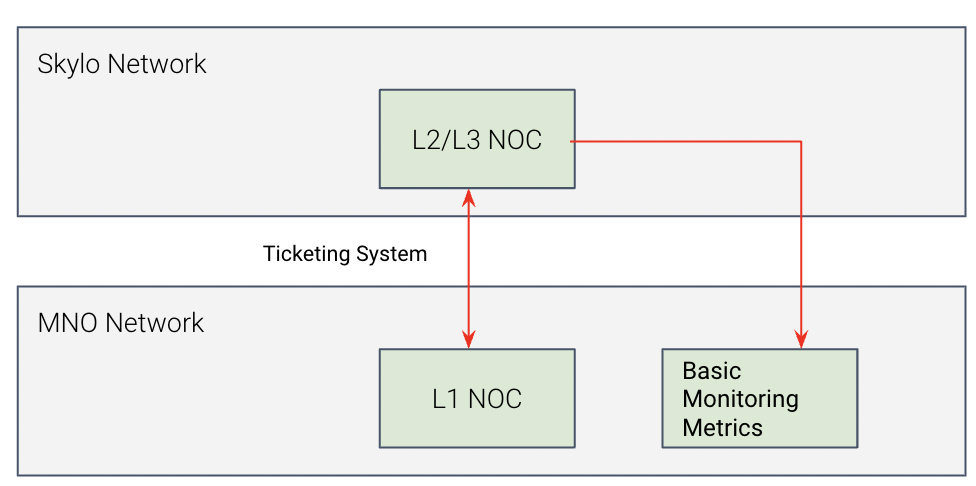
Skylo provides NOC L2/L3 support to M(v)NOs. Basic metrics and a ticketing system are made available to the terrestrial operator along with an escalation path with the Skylo NOC.
M(v)NOs will handle all L1 calls with their subscribers. If a satellite network issue is determined, M(v)NOs L1 tier will escalate the issue to Skylo L2 via a ticketing system, email or phone call for resolution.
Skylo will provide a ticketing system along with a NOC Email Id & also a 24/7 number to call. Please see Annexure A for more details on NOC Support
Network Integration
Skylo Core network can be integrated with MNO core Network in different ways, However, the common 2 ways are
- Core-to-core Integration via an IPX
- Core to Core Integration via an IPsec
Core to Core Integration Architecture
MNOs would like to integrate the core network using an IPX partner instead of directly integrating with the Core Network for authentication or for Data routing. Skylo network can be integrated using an IPX partner and below is the architecture defined. Currently IP Home Routing is supported & NIDD Home-Routing via T7 is TBD/Futur
Glossary
OCS
Used for Credit Control and updating of usage quota for pre-paid billing. It affects the billing data in realtime.
HSS
Combine the functionality of HLR and AuC
S-GW
Part of EPC for managing Control Plane functionality
P-GW
Part of EPC for managing and routing IP data traffic to PDN. It supports User-Plan functionality
NIDD
Non-IP Data path for Machine Data which offers efficient communication between IoT devices and enterprise applications. This data delivery method can help applications that transact small amounts of infrequent data.
MME
Manage session handling with UE and Area tracking list