1. Scope
The purpose of this document is to provide a comprehensive overview of Skylo satellite-based NTN (Non-Terrestrial Network) technologies and core services - This also Includes the features of the Network along with IP & Non-IP data transmission and SMS delivery.
2. Executive Summary
- Skylo’s Satellite-based NTN utilizes satellite beams to enable direct data communication with user devices, delivering reliable data services in remote areas that are beyond the reach of traditional cellular networks.
- Skylo Network provides data transmission services (e.g., eSOS) and SMS, with plans to continuously expand the range of services and use cases.
- Skylo-compatible devices—including smartphones, IoT devices, and automotive systems—can connect directly to Skylo NTN without requiring additional hardware modifications. Currently, over 1 million devices are connected to Skylo NTN, with major chipsets and flagship devices already supporting compatibility.
- By operating independently of carrier-owned frequencies, Skylo’s service requires no carrier spectrum.
- Skylo’s global network footprint offers commercial coverage across the United States, Canada, Europe, Australia, NZ & Japan with many additional regions set to launch soon.
3. Skylo Non-Terrestrial Network
3.1 About Skylo
Skylo's Non-Terrestrial Network (NTN) seamlessly integrates with terrestrial cellular networks. The company operates on a wholesale model, partnering with satellite providers to connect their existing infrastructure directly to standard cellular IoT devices and smartphones. To ensure compatibility, these devices must be equipped with Skylo-certified chipsets and modules that adhere to the 3GPP Release-17 specifications.
3.2 Skylo Non-Terrestrial Network
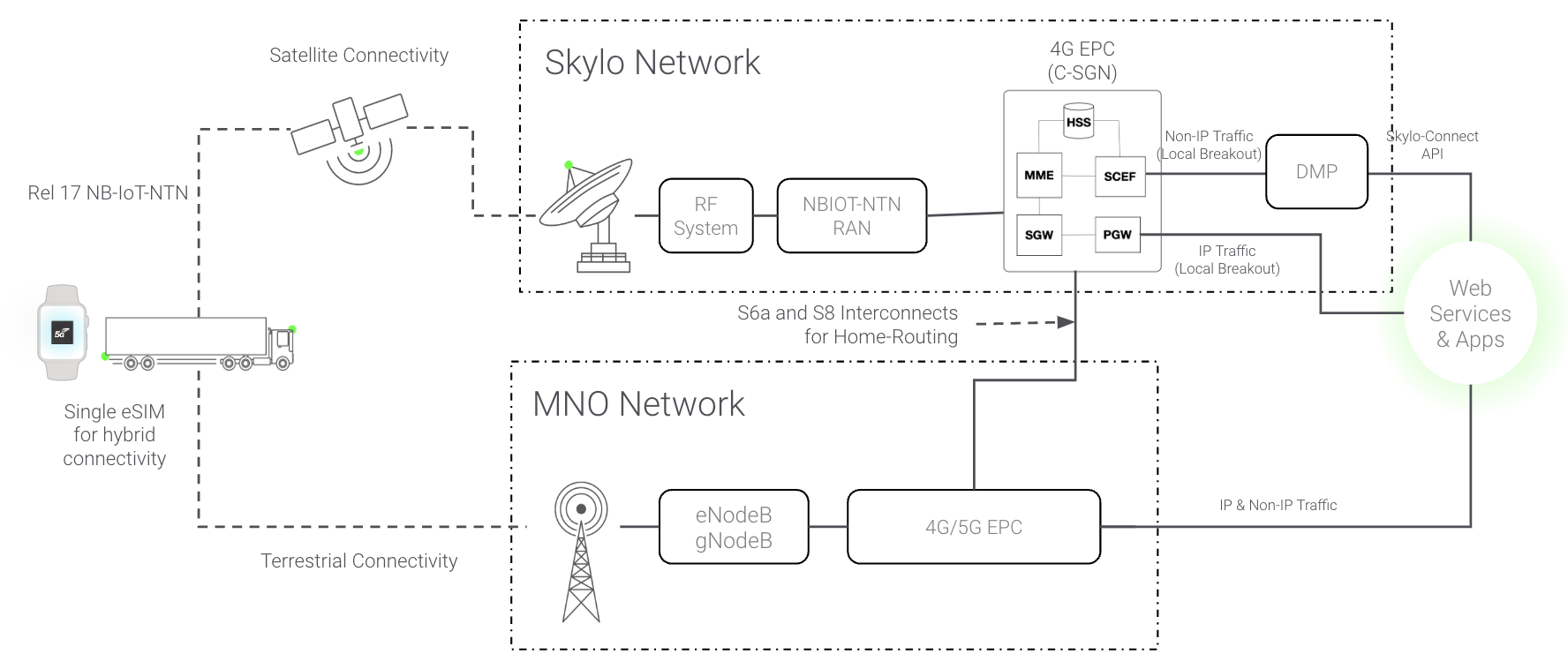
Skylo's Non-Terrestrial Network (NTN) represents a revolutionary advancement in satellite communications, seamlessly integrating 3GPP Release 17 standards with Narrowband Internet of Things (NB-IoT) technology. This innovative system transcends traditional connectivity boundaries, delivering reliable communication services to areas where conventional terrestrial networks struggle to reach or maintain consistent coverage.
A Carrier-Grade Service that is Scalable, Reliable, Dependable, Modular, and Replicable across any Earth Station, Satellite Operator, or Cloud Provider
- Optimized for low-bandwidth sensor and machine data
- Support for different classes of devices
- Delay-sensitive - real-time data such as alerts, notifications, control
- Delay-tolerant - near-real-time such as text messages, PoS/ATM transactions
- Delay-agnostic - periodic updates, scheduled reports, firmware downloads
- Dependable service with Reliable data delivery and bounded delays
Skylo's Non-Terrestrial Network (NTN) is a groundbreaking satellite communications solution. It combines 3GPP Narrowband Internet of Things (NB-IoT) protocol with Skylo's over 50 patented NTN technologies. This integration enables reliable communication services in regions with limited or unreliable terrestrial network coverage, effectively overcoming the limitations of traditional connectivity infrastructure.
When implementing a cellular network protocol over satellites, the fundamental operating characteristics of radio interface face significant challenges. The enormous distance to the satellite orbit (~ 36,000 km) introduces propagation delays approximately 500~600ms, vastly exceeding the millisecond-scale delays terrestrial systems are designed for. This disrupts core timing mechanisms, including random access procedures, Hybrid Automatic Repeat Request (HARQ) feedback, and synchronization processes. Additionally, the extreme path loss of 180-200 dB strains the link budget far beyond terrestrial norms, while Doppler shifts from Earth's rotation and satellite movement exceed conventional compensation mechanisms. These factors create substantial hurdles for reliable communication.
Skylo has engineered comprehensive solutions to these challenges. To combat the severe path loss, Skylo leverages enhanced link adaptation mechanisms while sophisticated frequency tracking compensates for satellite-induced Doppler effects. This holistic approach enables reliable NTN connectivity while preserving compatibility with regular user-device hardware, making global NTN connectivity both technically feasible and economically viable.
Skylo's utilization of the NB-IoT protocol for NTN communications is driven by the protocol's inherent suitability for the technical demands of satellite-based connectivity. The protocol's narrowband nature (180 kHz bandwidth) and robust modulation scheme provide excellent link budget properties, enabling reliable communication even with limited power and high path loss typical in satellite links. The protocol's simplified architecture and reduced signaling overhead, originally designed for massive IoT deployments, also proves advantageous in satellite scenarios where bandwidth efficiency and minimal protocol complexity are crucial.
The architecture of Skylo's NTN demonstrates remarkable engineering sophistication through its three interconnected segments. The space segment leverages Geosynchronous Orbit (GSO) satellites, maintained through strategic partnerships with satellite operators, which provide extensive regional coverage through multiple satellites operating in concert. Each satellite employs multiple beam transmission technology, where a single satellite can project numerous coverage beams, each significantly larger than conventional cellular network cells, enabling efficient wide-area service delivery. These satellites serve as communication bridges, orchestrating two distinct radio channels: a feeder link connecting to ground stations and a service link interfacing with user devices. Notably, Skylo's secured spectrum ownership eliminates the need for partners to acquire additional frequency licenses, streamlining the deployment process and reducing operational complexity for satellite operators and service providers partnering with Skylo.
The ground segment forms the intelligent core of the system, This advanced infrastructure integrates critical components, including a dedicated NB-IoT Radio Access Network (RAN) and a robust Evolved Packet Core (EPC). These elements are meticulously designed to comply with 3GPP Release 17 standards and further optimized to meet the unique requirements of NTN systems. The ground segment's architecture facilitates seamless interconnection with Mobile Network Operators' (MNO) core networks and application servers, enabling smooth integration of terrestrial and satellite communications. The eNB employs sophisticated data transmission techniques specifically optimized for GSO satellite characteristics, ensuring robust signal processing and efficient communication paths.
The user segment represents the consumer-facing interface of Skylo's NTN, featuring NB-IoT enabled devices that establish direct communication with satellites through optimized service links. A particularly significant achievement lies in the minimal modifications required for standard NB-IoT modules, making the technology both cost-effective and readily deployable. This approach has led to remarkable market adoption, with over one million devices actively connected to the live network as of October 2024, supported by an extensive certification program for major mobile devices and IoT chipsets.
The technical advantages of Skylo's NTN manifest in several key areas. The system provides enhanced reliability through dual-network redundancy, combining Skylo NTN with traditional cellular networks to ensure uninterrupted connectivity. The architecture demonstrates exceptional scalability, leveraging existing GSO satellite infrastructure and standardized roaming protocols for efficient network expansion. Cost-effectiveness is achieved through minimal hardware modifications and strategic utilization of existing satellite infrastructure. Power efficiency stands as another crucial benefit, with advanced NB-IoT protocols and optimized control plane communications minimizing device power consumption.
Security and authentication are seamlessly integrated into the system architecture. The user device is authenticated using a single standard MNO SIM card, with traffic securely routed back to the MNO network through Skylo's sophisticated roaming integration. This approach maintains familiar security protocols while enabling expanded coverage capabilities.
The current deployment status reflects the system's success and growing adoption. Beyond the million-plus connected devices, Skylo continues to expand its certified device ecosystem through partnerships with major mobile device manufacturers and IoT chipset providers.
As global connectivity demands grow, Skylo's NTN emerges as a cost-effective solution to extend coverage to areas beyond the reach of traditional cellular networks Skylo's NTN provides reliable and accessible connectivity in underserved regions, addressing critical coverage gaps. This innovative approach enables cost-efficient network expansion, making it an ideal choice for ensuring universal connectivity across diverse geographical and technological environments, both now and in the future.
4 Skylo NTN Network
4.1 General
Skylo's NTN enables Skylo-certified standard mobile devices to access satellite-based applications seamlessly when outside the coverage of TN, significantly enhancing user experience in remote or underserved areas. However, due to the significant distance between satellites and the Earth's surface, data transmission over satellite-based radio interfaces (service links and feeder links) inherently involves longer delays compared to TN. Additionally, limited bandwidth and lower signaling quality result in reduced data throughput per user compared to terrestrial networks.
Despite these challenges, Skylo's dedicated NTN infrastructure is specifically designed to support a wide range of mobile applications, ensuring reliable and efficient operation. By leveraging advanced NTN technologies and services, users can access critical communication services, including SMS and eSOS, even in areas beyond the reach of TN. This capability ensures uninterrupted connectivity, allowing users to stay connected and seek assistance during emergencies, regardless of their geographical location.
The scope of this section focuses on NTN-based services, particularly NIDD for applications like eSOS, as well as P2P SMS. These services are optimized to deliver essential communication capabilities in environments where traditional cellular networks are unavailable, further highlighting Skylo's commitment to ensuring universal connectivity.
4.2 Prerequisite
To ensure seamless integration and operation of NTN services, the following prerequisites must be met:
- The MNO network shall establish connectivity with the Skylo NTN using 3GPP standard-based S6a for mobile device service. The S6a interface enables the exchange of subscriber information and authentication between the Skylo NTN and the MNO's Home Subscriber Server (HSS). To ensure that only users authorized by the partner MNO can access and utilize Skylo NTN services, the system retrieves subscriber information from the MNO's HSS. This integration ensures that NTN connectivity and services are restricted to eligible users based on the MNO's authentication policies.
- For the SMS service, the MNO Short Message Service Center (SMS-C) should be configured to detect when a user is connected to the Skylo network and route SMS messages to the NTN user accordingly. This requires the SMS-C to correctly map the user's MSISDN to their IMSI, ensuring that messages are properly directed to the Skylo network for seamless delivery. This routing configuration is critical to enable uninterrupted SMS communication for Skylo users, regardless of their location within the NTN coverage area.
- For the NIDD based eSOS service, the MNO network shall configure a NIDD APN to enable the transfer of NIDD data between the Skylo network and MNO’s partner service providers.The NIDD APN should be associated with the Service Capability Exposure Function (SCEF) and the Data Mobility Platform (DMP) to facilitate the delivery of the NIDD packet.
- MNO shall establish a secure and reliable connection with an IP eXchange (IPX) provider to enable the exchange of signaling and data traffic between the MNO network and the Skylo NTN.
- UE can establish data communication paths by Attach Procedure defined by 3GPP standards. This procedure includes several steps: acquiring the Master Information Block (MIB) and System Information Block (SIB) to achieve timing synchronization and obtain cell information between the network and the UE. It also involves performing Random Access to secure radio resources for communication, followed by exchanging essential information between the UE and the Core Network. Once the Attach Procedure is complete, a data path is established across the UE, Satellite, RAN and Core Network. This enables the seamless exchange of control messages and NIDD data, facilitating the provision of NTN services with high reliability and efficiency.
- To establish a reliable connection, the device's operating system (OS) can assist users in achieving a clear LoS between the UE and the satellite by providing a Pointing UI. This interface guides users in orienting the device toward the satellite's position for optimal connectivity based on GPS (Global Positioning System) information and electronic compass.
4.3 NTN network features
Skylo Carrier-Grade Service that is Scalable, Reliable, Dependable, Modular, and Replicable across any Earth Station, Satellite Operator, or Cloud Provider.
The basic service features of the Network are
- NBIOT-NTN Features: Rel 17-NTN Standalone eNB, eDRX, PSM, MTU 256 Bytes, Control-Plane operation, Single-mode operation (3.75 KHz UL), Dynamic Repetitions and MCS, Coverage Enhancement Levels, Redundant eNBs, and Cloud-based HA.
- E2E Service Capabilities: Alerts, Paging, 2-way Messaging, Message Store and Retry, Periodic reporting, Single/Dual/Multi-Profile SIMs, Fixed Connections and Inbound Roaming, Simple Cell-to-Satellite Switching, Local Authentication and Breakout, Home Network Authentication and Routing, IP and NIDD, Enhanced Skylo API for Non-IP Application delivery, Lawful Intercept,
- Connectivity to M(V)NOs: via standard S6a and S8 interfaces
- Integrated Back-End Systems: OSS, SIM Preparer & Customer on-boarding, Device Activation, and Billing Systems with external APIs
- Customer SLA: Service Activation Time, Outage Response and Resolution times
- NOC & Customer Support: 24x7 L2/L3 Support
In the context of IoT devices and LTE networks, power consumption is a critical consideration. Two key features that significantly enhance battery life are Power Saving Mode (PSM) and Extended Discontinuous Reception (eDRX). Both are designed to optimize device power usage, particularly for devices that operate in low-power, low-data communication environments, such as sensors and tracking devices. Skylo Supports PSM & eDRX modes.
4.4 NIDD based Data Communication
Skylo NTN facilitates efficient data exchange using NIDD, a protocol optimized for satellite communication. NIDD eliminates traditional IP overhead, reducing transmission sizes by 20–40% and maximizing satellite bandwidth. Its streamlined design replaces complex IP protocols with a simplified stack, minimizing power consumption and processing demands on devices. By reducing handshakes and optimizing data packaging, NIDD addresses satellite latency effectively, enabling robust performance even under intermittent connectivity and signal variations. It also incorporates built-in security features without the overhead of traditional IP mechanisms. With direct application data delivery and efficient error recovery, NIDD is ideal for critical services like SOS and location sharing, providing reduced overhead, enhanced reliability, and simplified integration for satellite communication.
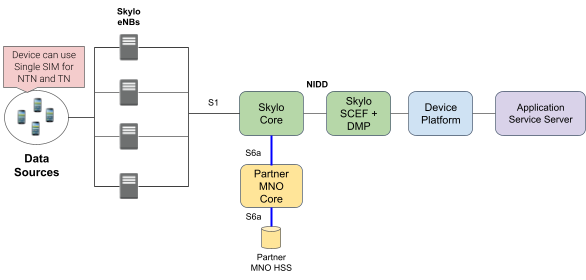
Figure 4.1. illustrates the interworking architecture between the Skylo NTN and MNO for the data communication, which utilizes NIDD for communication between the UE and the application service server.
As specified in 3GPP TS 23.682, the Service Capability Exposure Function (SCEF) serves as a key interface between the core network and external applications, exposing core network functionalities while managing data delivery and buffering for NIDD. This ensures efficient and reliable communication between the UE and application servers.
The MNO core network connects to the Home Subscriber Server (HSS) via the S6a interface, responsible for subscriber authentication and authorization. The S6a interface adheres to 3GPP TS 29.272 specifications, ensuring secure and standardized communication between the MNO core and HSS.
Skylo’s SCEF and Data Mobility Platform (DMP) deliver NIDD data to application providers, enabling seamless communication with devices using Non-IP data. This approach reduces overhead while optimizing resource utilization.
External NIDD service subscribers are authenticated by the MNO HSS using a Local Breakout APN, as outlined in 3GPP TS 23.401. This allows for direct data transmission to external networks, enabling seamless communication between UE and application servers.

Among NIDD’s applications, the Emergency SOS (eSOS) service is particularly critical, providing a vital lifeline in areas beyond traditional cellular coverage. The service enables users to transmit emergency alerts via satellite networks, including location data, user identification, and emergency classification. This ensures timely assistance in remote or disaster-affected regions.
The eSOS service operates through a sophisticated architecture that integrates mobile device capabilities, satellite networks, and Emergency Response as a Service (ERaaS) providers. Implementation details vary based on device operating systems and service provider infrastructure.
Skylo’s NTN eSOS service exemplifies a breakthrough in emergency response capabilities, leveraging satellite technology to ensure no one is beyond the reach of help, regardless of their location or terrestrial network availability.
4.5 SMS Service
Skylo NTN SMS service enables native SMS texting over satellite. The partner MNO user can send and receive peer-to-peer SMS even in areas without cellular coverage by utilizing Skylo NTN.
Skylo implements the "SMS in MME" feature as specified in 3GPP TS 23.272, which delivers SMS services over the Evolved Packet System (EPS) Non-Access Stratum (NAS) signaling for UEs requiring SMS functionality.
This service is available through the MNO network on Skylo-certified devices. The NTN SMS client on the device enables switches to satellite mode when no alternative network connectivity options are available.
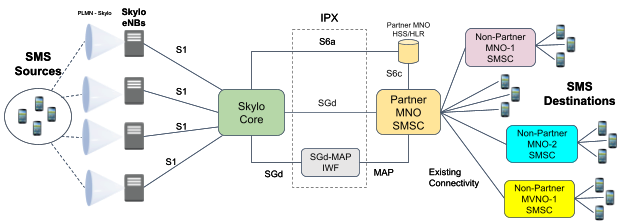
Figure 4.3. illustrates the example of interworking architecture between the Skylo NTN and MNO for the SMS using the direct SGd interface or SGd-MAP interworking function (IWF).
According to 3GPP TS 29.338, the SGd interface enables the transfer of SMS messages between the MME and the SMSC using Diameter protocol. If the partner MNO’s SMS-C uses MAP protocol, the SGd-MAP IWF is required. The SMS message is exchanged between Skylo’s MME and the MNO SMS-C via the SGd-MAP interworking interfaces.
MNO’s SMS can route the SMS to the final destinations, which can be either MNO's own SMSC for internal delivery or a Non-Partner MNO’s SMSC for external delivery.
The Skylo MME authenticates the device's International Mobile Subscriber Identity (IMSI) against MNO's HSS. This ensures that only authorized devices can send and receive SMS messages through the Skylo NTN and MNO network.

4.5 Roadmap ahead
Beyond the established eSOS and SMS capabilities, Skylo is actively developing an extensive suite of applications optimized specifically for NTN communications. Through strategic collaborations with various application providers, Skylo is preparing to launch several innovative services that leverage satellite connectivity for diverse use cases. We are working on provide voice capabilities on the NTN network by end of 2025
5. Glossary

6. References
[1] 3GPP TS 36.300 - Overview of E-UTRA and E-UTRAN.
[2] 3GPP TS 29.002 - Mobile Application Part (MAP) Specification
[3] 3GPP TS 29.338 - Diameter protocol for S6a, S6d, S13, S13', and SGd interfaces.
[4] 3GPP TS 23.040 - Technical realization of SMS.
[5] 3GPP TS 23.401 - General Packet Radio Service (GPRS) enhancements for Evolved Universal Terrestrial Radio Access Network (E-UTRAN) access
[6] 3GPP TS 23.682 - Architecture enhancements to facilitate communications with packet data networks and applications
[7] 3GPP TS 29.272 - MME and SGSN related interfaces based on Diameter protocol
[8] 3GPP TS 29.305 - InterWorking Function (IWF) between MAP based and Diameter based interfaces